


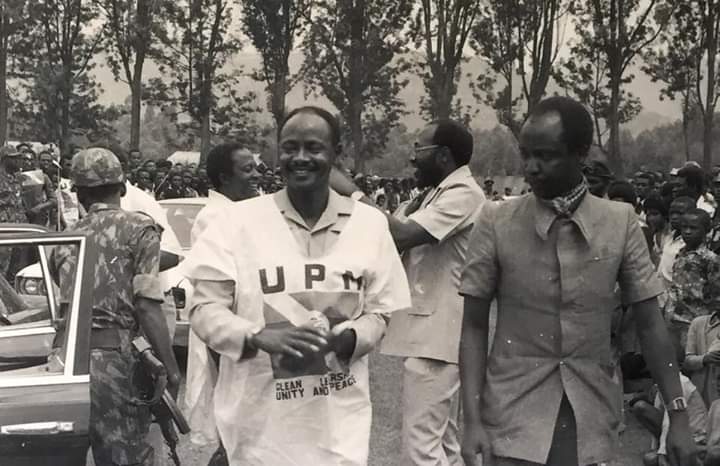
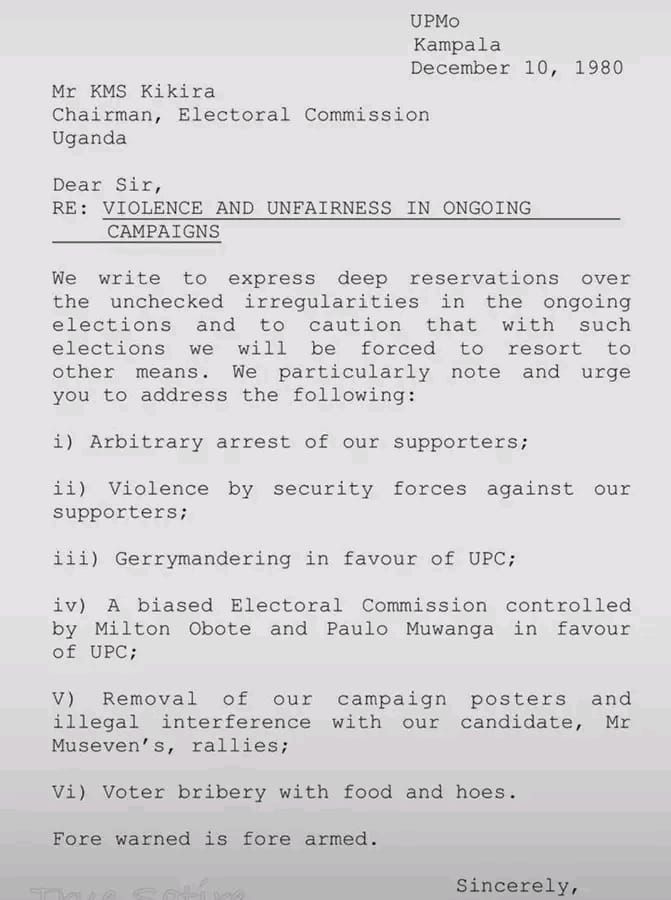
In December 1980, Yoweri Museveni—then a young politician and leader of the Uganda Patriotic Movement (UPM)—wrote an angry letter to the Electoral Commission. In it, he catalogued a chilling list of election abuses under the Obote government: arbitrary arrests of his supporters, violence by security forces, biased electoral institutions, gerrymandering, destruction of campaign materials, and bribery of voters.
Forty-five years later, the irony could not be more striking. Many of the same accusations he levelled against Obote’s UPC regime are now the very complaints raised by his opponents. The letter, once a symbol of resistance against state abuses, reads today like a prophetic indictment of the government he has led since 1986.
1. Arbitrary Arrests — Then and Now
In 1980, Museveni condemned the arrest of his supporters. Today, opposition figures—from Dr. Kizza Besigye to Robert Kyagulanyi (Bobi Wine)—have repeatedly been detained, often without charge. Supporters are rounded up during campaign seasons, with many disappearing into unofficial detention sites. The pattern mirrors the very oppression Museveni vowed to end.
2. Violence by Security Forces
Museveni’s 1980 letter decried the brutality of security forces against civilians. Yet modern Uganda has witnessed the same:
– Shootings during opposition rallies
– Beatings by military police
– Enforced disappearances
– The infamous November 2020 killings of more than 50 people during protests
Uganda’s security apparatus, once accused of shielding a dictator, is now accused of serving the same role under Museveni.
3. Biased Electoral Commission
In 1980, Museveni insisted that Obote controlled the Electoral Commission. Today, critics point to a Commission appointed almost entirely by the President, often perceived as partial and acting to secure NRM dominance.
Every opposition candidate—Besigye, Amama Mbabazi, Kyagulanyi—has challenged the Commission’s neutrality, just as Museveni once did.
4. Gerrymandering to Favour the Ruling Party
Museveni warned that electoral boundaries were being manipulated.
Under his rule, Uganda’s constituencies have multiplied to over 500, often carved along political calculations to secure NRM seats and dilute opposition strongholds.
What he condemned in Obote has become a routine electoral strategy in the Museveni era.
5. Interference With Campaigns and Destruction of Posters
The 1980 letter complained about destruction of UPM posters and disruption of rallies.
Today, security forces routinely block opposition rallies, fire tear gas, seize sound equipment, and remove campaign materials. The pattern is so consistent that it has become an expectation, not an exception.
6. Bribery With Food and Supplies
Museveni once accused Obote of bribing voters with food and hoes.
Today, the NRM distributes:
– sachets of money
– yellow T-shirts
– food
– hoes
– pledges of parish funds
– promises of jobs
The very practices he condemned have become central tools of his political machinery.
A Full Circle of History
The greatest irony of Museveni’s legacy is that the abuses he used to justify the 1981–1986 guerrilla war—rigged elections, brutality, and repression—now mirror his government’s own conduct.
The letter from 1980 stands today as a symbolic mirror, reflecting how a liberator can slowly morph into the kind of ruler he once resisted.
Ugandans who read the document today cannot help but ask:
Did Museveni fight Obote’s dictatorship only to build his own?
Whether one views the events as political necessity, system failure, or betrayal of the liberation promise, one fact remains undeniable: the accusations Museveni made in 1980 now echo loudly in the complaints of his opponents. History, it seems, has come full circle.




Thanks very much.
As in H.E. Dr. Apollo Milton Obote said “musebeni not a Ugandan but he’ll give him chance to lead the country incase he wins election”
This foreigner did everything to plait a worse picture on Obote so that he may fulfill his own interests not for Ugandans. If Amin who never went to school led 🇺🇬 Uganda just 8 years and it approaching a developed level of country status what can this goon say after 40yrs. Kidnaps, land grabbing, terrorism,poor roads,no hospitals,poor and unfunctioning judiciary,extreme poverty etc. To hell museveni and his descendants