


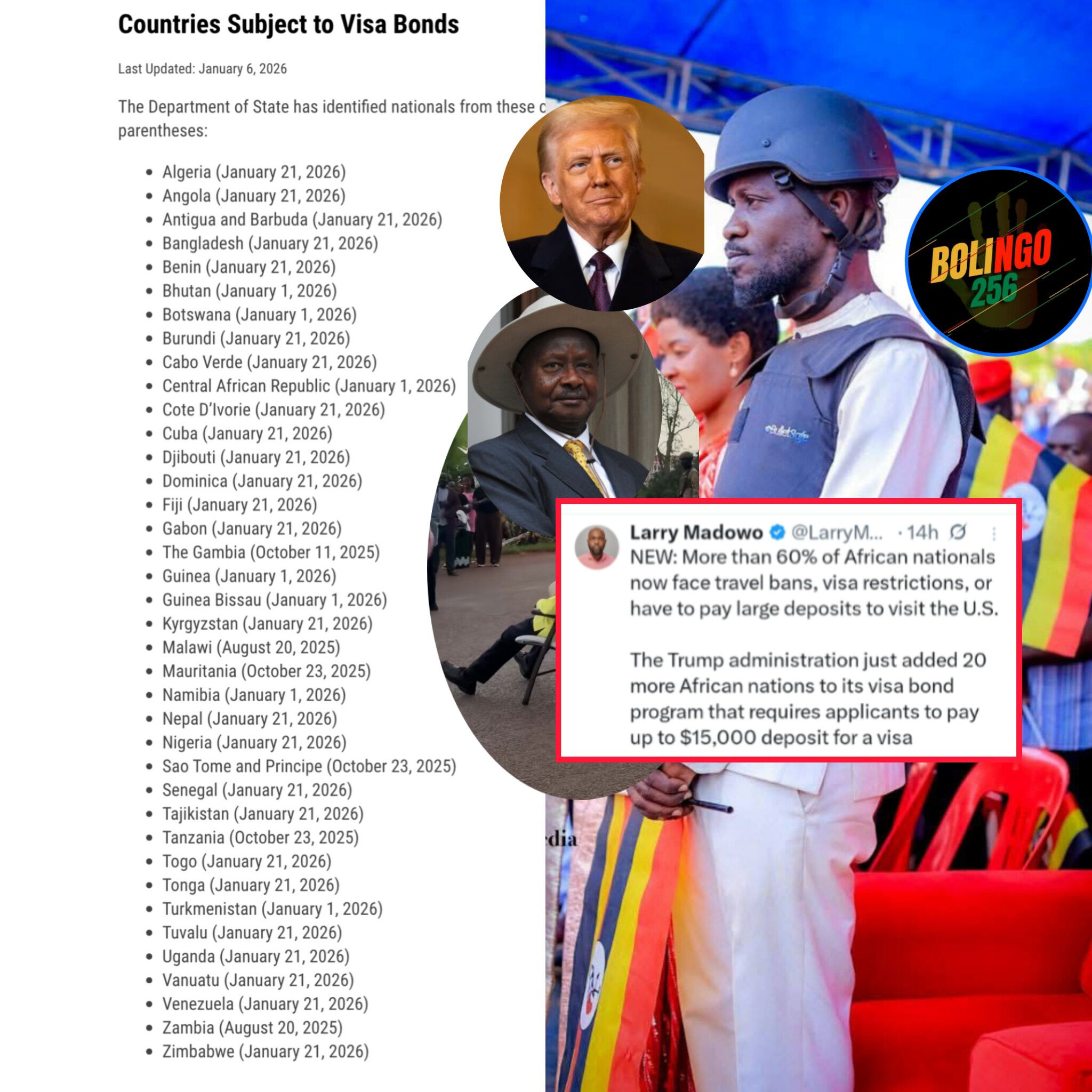
Ugandans face UGX 57 million U.S. visa security deposit as a new travel requirement. By The Pearl of Africa News Reporter
January 2026
Uganda has been listed among African countries affected by the expanded United States visa bond program. This move significantly tightens travel requirements for selected foreign nationals and places a heavy financial burden on would-be travelers. The decision follows the announcement by the U.S. administration to add 20 more African nations to the controversial program. Consequently, more than 60 per cent of the African continent is now impacted by tougher U.S. travel rules. Ugandans face UGX 57 million U.S. visa security deposit requirements as part of this expanded policy.
Under the expanded policy, some applicants from the affected countries, including Uganda, may be required to pay a visa bond. This is a refundable security deposit of up to USD 15,000 before a non-immigrant visa is approved. The bond is intended to ensure visitors comply with U.S. immigration rules, including leaving the country before their visas expire.
At the current exchange rate, USD 15,000 is equivalent to approximately UGX 57 million (based on an average rate of UGX 3,800 per U.S. dollar). For most Ugandans, this amount is far beyond reach. This effectively places U.S. travel out of bounds for ordinary citizens, students, and small-scale businesspeople. Ugandans face UGX 57 million for the U.S. visa security deposit, which is a significant barrier.
“For many Ugandans, a UGX 57 million visa deposit is not just restrictive — it is prohibitive,” immigration analysts note.
Why Uganda is affected
The U.S. government has justified the expansion of the visa bond program on grounds of national security and immigration compliance. Countries with higher rates of visa overstays, according to U.S. authorities, are more likely to be placed under stricter controls. While Washington has not publicly singled out Uganda for specific violations, analysts say the decision reflects broader concerns about immigration enforcement rather than individual traveler conduct. For Ugandans, facing UGX 57 million U.S. visa security deposit becomes an additional challenge when considering travel.
Ugandan officials have so far responded cautiously. Diplomatic sources indicate that discussions may be pursued through bilateral channels to clarify the scope and application of the policy.
“The inclusion of Uganda in the visa bond program raises serious questions about fairness and collective punishment,” said a regional policy expert based in Kampala.
Impact on students, traders, and families
The policy’s consequences are likely to be felt most sharply by Ugandan students seeking education opportunities in the United States. Businesspeople attending trade expos and families visiting relatives abroad are also affected. Even though the bond is theoretically refundable if visa conditions are respected, the upfront cost alone is enough to deter applications for many who must face the UGX 57 million U.S. visa security deposit as Ugandans.
For students, securing UGX 57 million on top of tuition fees, accommodation, and living expenses makes U.S. education an increasingly distant dream. Small traders and entrepreneurs, who often rely on short-term travel to build international networks, are similarly affected.
“This policy quietly shuts the door on social mobility and global exposure for Africans,” a Kampala-based education consultant observed.
Africa bears the brunt
With 20 additional African countries added, the visa bond expansion now affects a majority of the continent. Critics argue that Africa has been disproportionately targeted, reinforcing perceptions of unequal treatment in global mobility regimes.
Human rights organizations have also raised concerns that the policy deepens inequality. It favors wealthy travelers, while excluding the middle and lower classes.
“Visa bonds turn freedom of movement into a privilege of the rich,” one civil society advocate commented.
What happens next?
While the U.S. maintains that the program is selective and not universally applied to all travelers from affected countries, the lack of transparency around who must pay the bond has fueled anxiety among potential applicants in Uganda.
As Kampala weighs its diplomatic options, many Ugandans are left grappling with a sobering reality. Access to the United States — once difficult but attainable — is now increasingly defined by one’s financial muscle. The challenge intensifies as Ugandans face UGX 57 million U.S. visa security deposit.
For now, Uganda joins a growing list of African nations navigating stricter global travel rules. This highlights once again the widening gap between policy decisions made abroad and their everyday impact at home.