


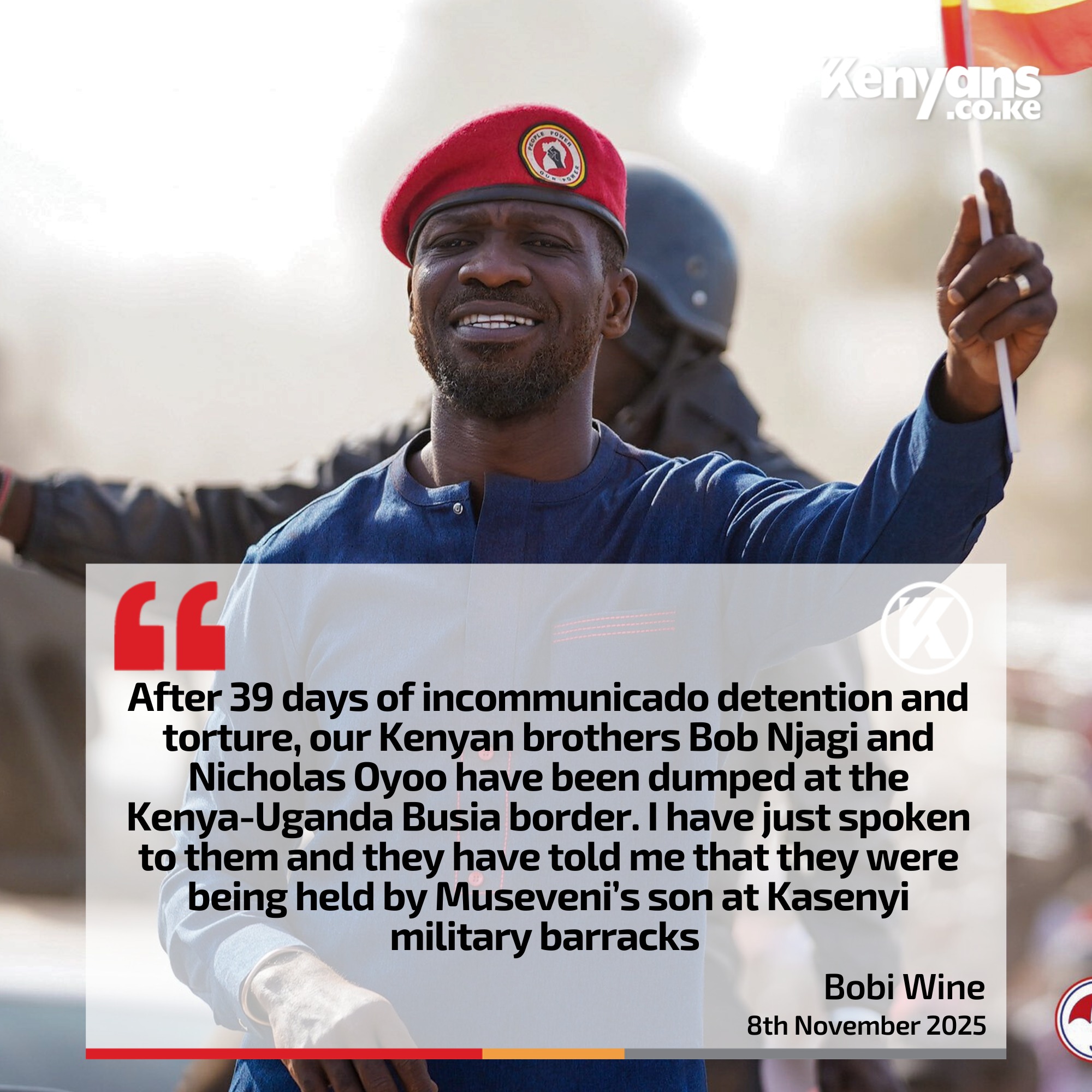
Nairobi / Kampala – November 8, 2025
For thirty-nine excruciating days, Bob Njagi and Nicholas Oyoo were ghosts.
They vanished without a trace, swallowed whole by the shadows of Uganda’s powerful military machine — their phones dead, their families silenced, their names whispered only in fear.
Today, the two Kenyan human-rights defenders are finally free — but their story reads like a political thriller ripped from the darkest corners of East Africa’s security apparatus.
The Vanishing: A Rally, a Raid, and a Sudden Silence
It began on October 1, 2025, in Uganda’s Kira–Wakiso district, during a fiery opposition rally for Robert Kyagulanyi, better known as Bobi Wine.
Witnesses recall the moment clearly: two unfamiliar men, Njagi and Oyoo, were helping set up banners when black SUVs with tinted windows screeched to a halt. Within minutes, the men were surrounded by armed soldiers in plain clothes.
“They were shoved into the cars like criminals,” said one witness, still shaken. “We didn’t know if we’d ever see them again.”
Their phones went dead that same hour. By nightfall, they had disappeared.
39 Days of Darkness
For five and a half weeks, Uganda’s security agencies denied holding the men. Court petitions were filed, human-rights groups mobilized, and Kenya’s diplomats demanded answers. The official response was chillingly consistent:
“We do not have them.”
But behind closed barracks walls, a different story was unfolding.
Sources inside Uganda’s Chieftaincy of Military Intelligence (CMI) now claim the Kenyans were detained at Kasenyi Barracks, a heavily guarded military facility near Entebbe — a place described by ex-detainees as a “black site” where suspects vanish into legal limbo.
“They were beaten, interrogated about their links to the opposition, and warned never to step foot in Uganda again,” a human-rights lawyer familiar with the case told us. “This was not an arrest. It was an abduction.”
Diplomatic Pressure and a Midnight Deal
By late October, the case had become a diplomatic flashpoint between Nairobi and Kampala. Kenya’s Foreign Affairs CS Musalia Mudavadi reportedly issued a diplomatic note to Uganda’s Foreign Ministry, demanding proof of life.
Behind the scenes, intense negotiations unfolded between the two countries’ intelligence agencies — culminating in a covert handover at the Busia border on the night of November 7.
At 11:45 p.m., a white van with Ugandan military plates pulled up at the border gate. Two dazed, gaunt men emerged — barefoot, visibly weak, and clutching plastic bags with their few belongings.
“It felt unreal,” said an officer at the scene. “They were alive — but you could see the fear in their eyes.”
The Aftermath: A Nation Demands Answers
Kenyan civil-rights groups have erupted in outrage, calling the detention a “state-sanctioned kidnapping” and a gross violation of international law.
“This was a clear case of extra-judicial detention — our citizens held incommunicado on foreign soil,” said Nelson Havi, a lawyer representing the activists’ families. “If this can happen to them, it can happen to anyone.”
The Ugandan government, meanwhile, has maintained an uneasy silence. No statement, no apology, no explanation.
Behind the Curtain: The Shadow of Muhoozi
Sources close to Uganda’s opposition allege that the detention was orchestrated under the watch of General Muhoozi Kainerugaba, President Yoweri Museveni’s son and the powerful commander of the Uganda People’s Defence Forces.
Bobi Wine himself accused Muhoozi of running a “shadow detention network” targeting perceived foreign allies of Uganda’s opposition.
“Njagi and Oyoo were not criminals — they were guests who believed in democracy,” Wine said at a press conference. “What happened to them is what happens to every Ugandan who dares to speak out.”
The Bigger Picture: Fear Without Borders
This saga exposes a dangerous reality — that political fear in East Africa is no longer confined by national borders.
Experts warn that if unchecked, such disappearances could erode the very spirit of the East African Community (EAC), founded on free movement and regional solidarity.
“When activists are kidnapped across borders, it’s not just an attack on individuals — it’s an attack on democracy itself,” said Dr. Wanjiru Ndirangu, a regional policy analyst.
Homecoming, But No Closure
Back home in Nairobi, the two men are recuperating under medical supervision. Their families say they’re still too traumatized to speak publicly, though they’ve vowed to testify once they regain their strength.
Their release brings relief — but also a chilling reminder of how easily the powerful can silence dissent.
“They disappeared for 39 days,” one family member said. “What terrifies us is how easily it could happen again.”
The Last Word
Bob Njagi and Nicholas Oyoo’s freedom is being celebrated — but the ghosts of their captivity linger.
Their ordeal has ripped open the veil on East Africa’s growing culture of impunity and intimidation.
Until someone answers for what happened in those secret Ugandan cells, their story remains unfinished — a haunting question mark in the heart of the region.