


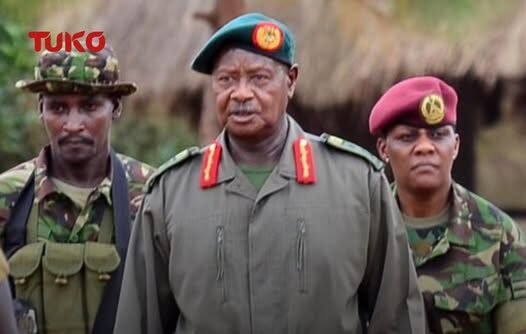
President Yoweri Museveni has shifted from his long-standing push for Indian Ocean access to champion a unified East African Community (EAC) army under a single command, signalling a transformative step toward regional integration and shared security.
Ugandan President Yoweri Kaguta Museveni has unveiled a dramatic shift in his regional strategy — moving away from his earlier fixation on securing access to the Indian Ocean and instead championing the creation of a unified East African Community (EAC) army under one central command.
Museveni’s new position, announced during a high-level regional integration and security forum, has sparked intense debate among political analysts, defence strategists, and member states across East Africa. The proposal is being viewed as one of the president’s most ambitious integrations efforts yet, signalling a move toward a stronger, more cohesive bloc.
“East Africa must stop acting like seven different islands,” Museveni warned. “A single army is the true foundation of real integration.”
A Vision Beyond Borders
For years, Museveni frequently emphasized Uganda’s landlocked challenges and expressed grievances about lacking a direct route to the Indian Ocean. His rhetoric often revolved around strengthening trade corridors through Kenya and Tanzania to ensure smoother maritime access for Uganda’s exports and imports.
However, his latest message indicates a recalibration of priorities. Rather than advocating for unilateral economic leverage, Museveni is now promoting collective security as the engine of shared strategic advantage.
His argument is straightforward:
If the region adopts one defence structure, one command, and one unified doctrine, then economic and security benefits — including stable maritime access — would follow naturally.
“A fragmented defence posture weakens all of us,” Museveni said. “A united East African force would transform our global standing and our internal stability.”
Why a Single EAC Army?
Museveni outlined several benefits of the proposed unified force:
- Stronger deterrence against foreign interference
- Reduced defence spending through shared resources
- Streamlined peacekeeping operations
- Improved border security and counter-terrorism
- Greater leverage in global diplomacy
He argued that Africa’s historical weakness lies in “small, colonial-era states” maintaining isolated armies instead of uniting under a powerful regional command.
Support, Skepticism, and Sovereignty Concerns
While some EAC leaders have expressed cautious agreement, others remain wary. Integrating national armies raises fundamental questions:
- How much sovereignty would states surrender?
- Who controls the command structure?
- How would budget contributions be determined?
- Could political tensions undermine unity?
Security experts have noted that the idea, although visionary, represents one of the most complex undertakings in regional integration history.
Toward a United States of East Africa
Museveni’s proposal feeds into a larger dream long floated in Pan-African circles — the creation of a politically federated United States of East Africa.
Analysts say his latest move is not merely military positioning, but a strategic step to accelerate regional federalism, tying together defence, governance, and economic policy.
Whether the EAC is ready for this level of integration remains uncertain, but Museveni’s shift marks a decisive moment in East African geopolitics.