


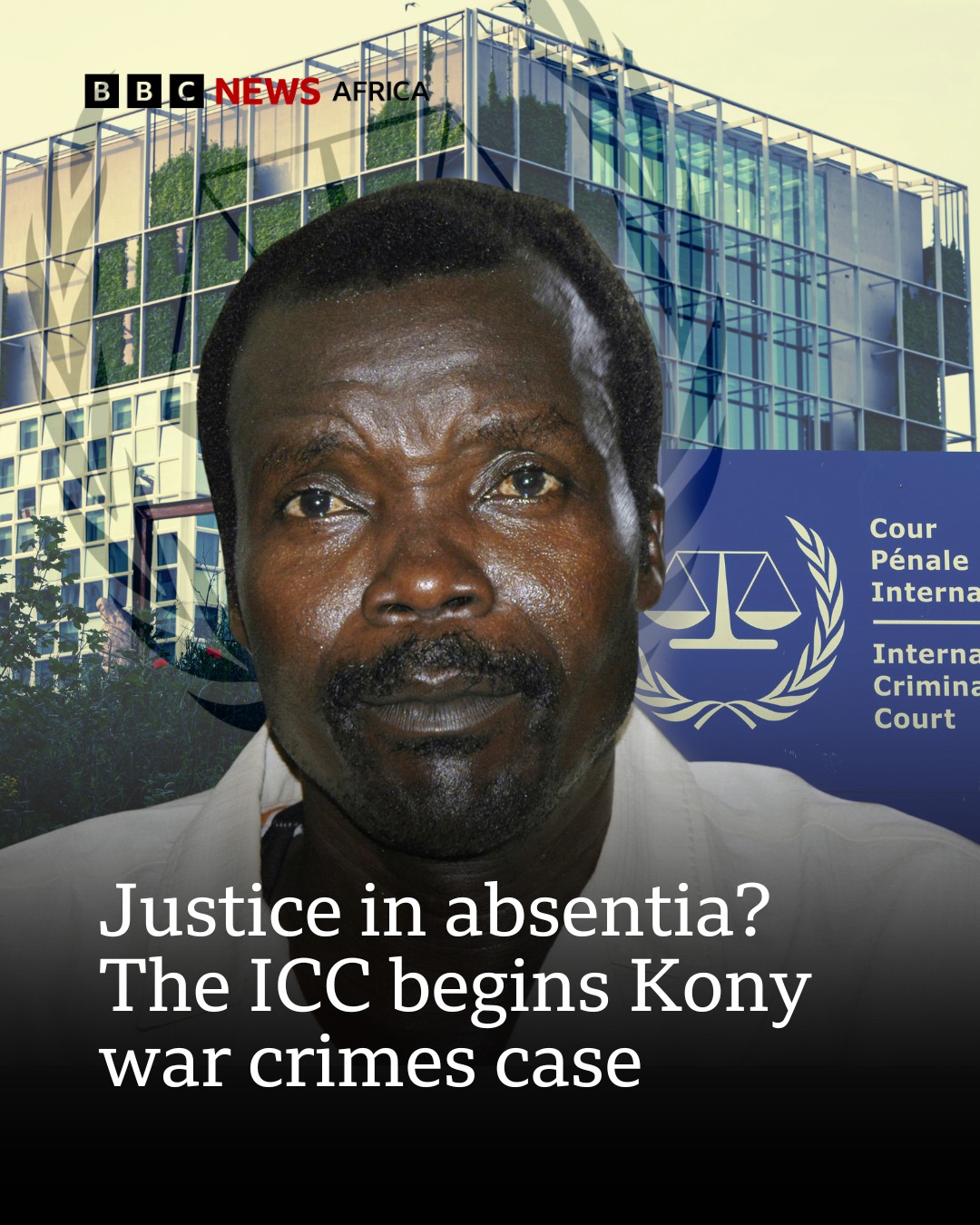
The International Criminal Court (ICC) has confirmed 39 charges of war crimes and crimes against humanity against Joseph Kony, the fugitive leader of Uganda’s Lord’s Resistance Army (LRA), marking a rare in-absentia proceeding in the court’s history.
November 7, 2025 | Kampala/The Hague
The Hague, Netherlands —
The International Criminal Court (ICC) has confirmed 39 counts of war crimes and crimes against humanity against Joseph Kony, the elusive founder of the Lord’s Resistance Army (LRA), a rebel group notorious for decades of brutal violence across northern Uganda and parts of Central Africa.
“The Chamber finds substantial grounds to believe that Joseph Kony ordered widespread attacks on civilians and the abduction of children,” ICC presiding Judge Rosario Salvatore Aitala stated in the ruling.
Kony, who remains at large nearly two decades after his 2005 arrest warrant, was charged in absentia—a highly unusual step for the world court, which traditionally requires the accused to be present during pre-trial proceedings.
The Charges
The ICC’s confirmation includes 10 counts of crimes against humanity—among them murder, enslavement, sexual slavery, and forced pregnancy—and 29 counts of war crimes, including recruiting child soldiers, pillaging, and attacks on civilian populations.
“These crimes left scars that generations in northern Uganda continue to bear,” said human-rights advocate Grace Acan, herself a survivor of the LRA’s abductions.
The crimes span the period from July 2002 to December 2005, when the LRA’s campaign against the Ugandan government reached its most violent peak, displacing nearly two million people and abducting tens of thousands of children.
A Symbolic Step Toward Justice
Analysts and victims alike view the confirmation as a symbolic but vital step toward accountability, even though Kony’s trial cannot proceed until he is captured.
“This decision restores hope that justice is possible, even after so many years,” noted Betty Oyella Bigombe, a former peace negotiator who once led talks with the LRA.
The ICC’s move is seen as precedent-setting—potentially paving the way for future cases against fugitives whose arrests remain elusive.
Still at Large
Kony, believed to be in his mid-60s, has evaded capture since the collapse of peace talks in 2006. Intelligence reports over the years have placed him in the remote border regions of the Central African Republic, South Sudan, or Sudan’s Darfur.
Despite multiple regional and international manhunts—most notably the U.S.-backed Operation Observant Compass—his whereabouts remain unknown.
What’s Next
The ICC emphasized that while the charges are now legally confirmed, a full trial cannot begin without Kony’s physical presence in The Hague. Uganda’s government reiterated its commitment to cooperating with the court, though frustration remains high among survivors awaiting closure.
“Justice delayed is still better than justice denied,” said Bishop Santo Okot of Gulu Archdiocese, urging continued international pressure for Kony’s arrest.
For the thousands who endured the LRA’s atrocities, the ICC’s ruling stands as both a reminder of their suffering and a promise that the world has not forgotten their stories.