


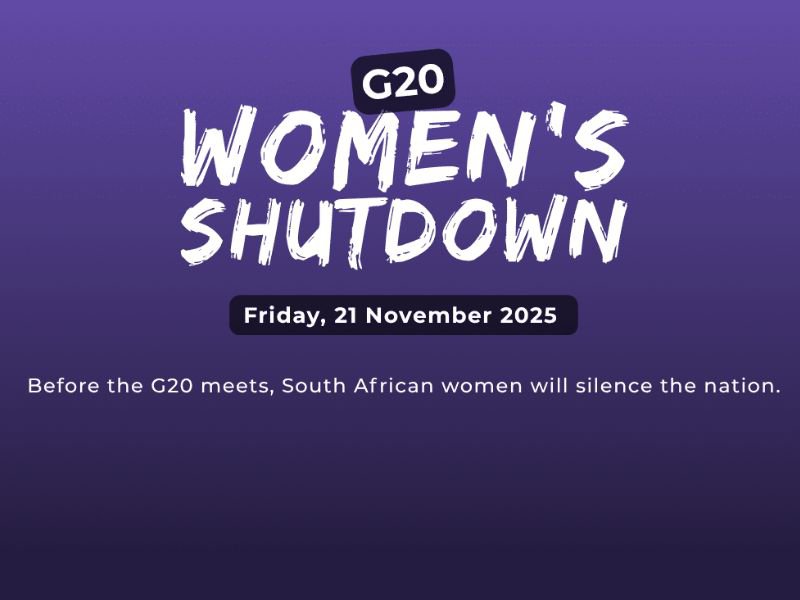
South African women are spearheading a powerful National Women’s Shutdown in South Africa ahead of the G20 Summit, demanding urgent action to end gender-based violence and femicide. The National Women’s Shutdown in South Africa is explored in this article, highlighting the movement’s momentum, nationwide support, and the call for global accountability.
A Growing Force Ahead of the G20 Summit
South African women have turned a desperate nationwide plea into a coordinated movement as they prepare to shut down the country in protest against gender-based violence and femicide (GBVF).
What started as an urgent call initiated by women has now intensified into a national mobilisation that is gaining traction in every province, every community, and every sector of society.
The timing of this mobilisation—just days before the G20 Summit—adds weight to their message: South Africa cannot claim progress or stability while women continue to die in staggering numbers. The National Women’s Shutdown in South Africa conveys the urgency of their cause to international audiences.
“We Cannot Speak of Growth While Women Are Being Killed”
Women for Change, a leading advocacy group, has been unwavering in its message. Their stance is central to the National Women’s Shutdown in South Africa, becoming a rallying cry for thousands joining the movement.
“World leaders cannot speak of growth and progress while countless women are violated and killed each day.”
This statement has ignited debate nationwide, challenging both government and global leaders to confront the reality of South Africa’s GBVF epidemic. While the country has declared GBVF a national crisis, activists argue that accountability remains painfully absent.
A National Shutdown Designed to Sound the Alarm
The evolving National Women’s Shutdown movement calls on South Africans from all walks of life to pause their usual activities—symbolically bringing the country to a halt.
Workplaces, schools, transport routes, community centres, and business hubs are expected to participate in various forms of peaceful protest.
The shutdown is intended not only to create disruption but also to deliver a message that cannot be ignored: women are dying, families are grieving, and communities are breaking under the weight of unchecked violence.
Pull Quote
“This is not just a protest—this is a national cry for survival.”
Women Transform Pain Into Mobilisation
Reports show that women have been “crying for help” for years, often unsupported or unheard. Now, with momentum building, these voices have unified into one of the most powerful grassroots movements, forming the National Women’s Shutdown South Africa, that the country has seen in recent years.
Civil society organisations, student groups, labour unions, and faith-based networks have pledged their support. Many describe the shutdown as a turning point—a chance for South Africa to confront its most devastating plague.