


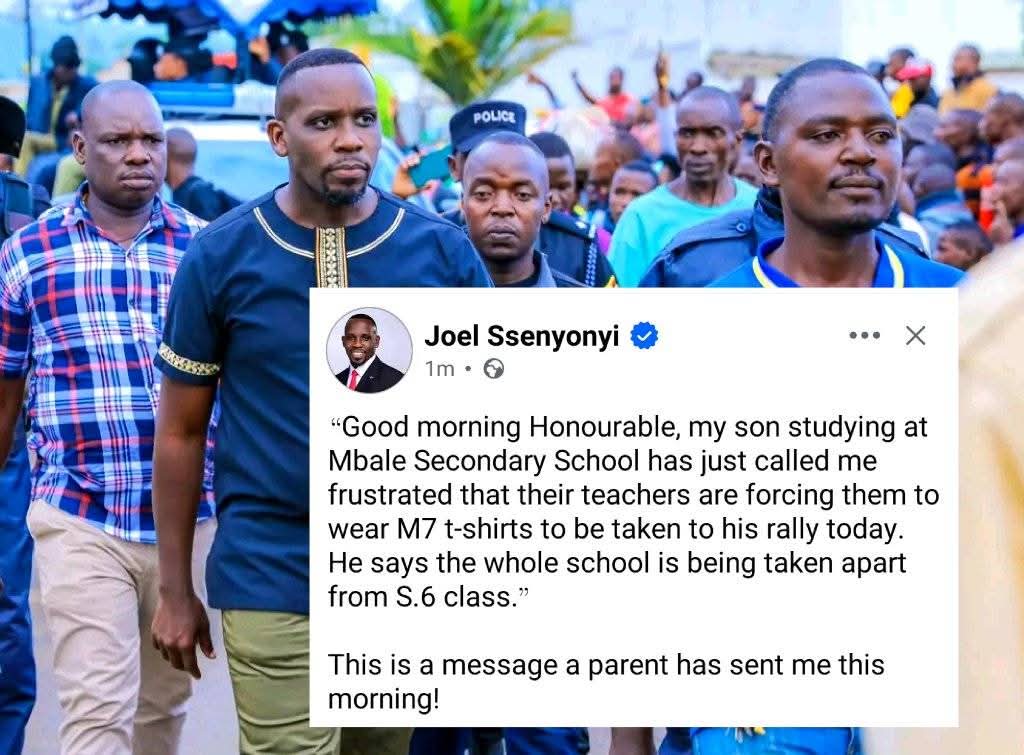
Children in school uniforms are being mobilized to attend President Yoweri Museveni’s political rallies, sparking outrage over educational disruption and the blurring of democracy in Uganda’s four-decade-long rule.
KAMPALA, Uganda — In the heart of Uganda’s campaign season, a troubling sight has ignited fierce debate: thousands of schoolchildren, some barely teenagers, filling stadiums and public squares in school uniforms, waving flags, and chanting slogans for President Yoweri Museveni — a leader whose iron grip on the nation has lasted for nearly 40 years.
Recent reports have revealed that in districts across the country, school administrators were reportedly instructed to organize pupils and transport them to political rallies, raising urgent questions about coercion, the sanctity of education, and the integrity of Uganda’s democratic process.
“No wonder … half of the people you’ll see are children, sometimes putting on school uniform!”
— Opposition leader Robert Kyagulanyi Bobi Wine
The practice, critics argue, is more than a minor campaign tactic; it’s a window into the broader mechanisms of control that have allowed Museveni to remain in power since 1986. Opposition leaders, human rights groups, and concerned parents warn that such mobilization undermines learning, pressures children into political spectacle, and distorts electoral fairness.
“They refer to us as their bazukulu,” said one Ugandan teacher on condition of anonymity, alluding to Museveni’s frequent paternalistic language. “It’s as if Uganda is their household, and we, the citizens, are simply part of the furniture.”
Reports show that some rallies have taken place dangerously close to examination centers and school grounds, disrupting education and violating the right of children to uninterrupted learning. Yet, official responses have largely framed youth participation as civic engagement or national development, leaving parents and watchdogs skeptical.
The implications extend beyond one election. Uganda’s political landscape has long been shaped by the blurring of party and state, and the mobilization of children reflects a larger pattern of controlling society from an early age. Forty years into Museveni’s rule, critics argue, the lines between governance and paternalistic domination are disturbingly thin.
“Generation after generation is being co-opted into political theatre,” said a civic education advocate. “It’s not just about votes — it’s about loyalty cultivated before they even graduate.”
For Uganda’s children, the consequences are clear: education disrupted, childhoods politicized, and civic autonomy compromised. As the country approaches yet another election cycle, the image of school uniforms in stadiums may become a haunting symbol of a democracy overshadowed by decades of one man’s rule.
Whether these children are true participants or unwitting props, the spectacle raises a chilling question for Uganda: after nearly four decades of Museveni’s presidency, who is truly shaping the nation — the citizens, or the regime?